The Daily Pilgrimage
“Now therefore, ye children, hear me: Blessed are they that keep my ways.” — Proverbs 8:32
Daily formation
2027-07-25
Receive the day as a child of Holy Mother Church. Beneath Our Lady's care, magnify Christ, obey God's commandments, fulfill the duties of your state in life, die to self, trust divine Providence, resist error, and return the whole day to God.
Holy Mother Church gathers her children around the Sacred Calendar, feeds them with truth, warns them against what wounds the soul, and teaches them to walk faithfully toward their heavenly home.
“Fear not, little flock, for it hath pleased your Father to give you a kingdom. […] For where your treasure is, there will your heart be also.”
Choose a date
Daily navigation
St. James the Greater, Apostle
City of God in Exile
St. James the Greater, Apostle
2027-07-25 - Time after Pentecost - Double of the Second Class - red
Today
St. James the Greater, Apostle
Can You Drink the Chalice?
Truth
The Faith Must Be Confessed Publicly
Catholic faith is not a private sentiment. It must be confessed, defended, and lived before men when duty requires it.
Practice
Apostolic courage: courage to profess Christ, serve others, and remain faithful under suffering.
Accept the duties you would rather avoid and perform them without seeking recognition.
Offering
To Jesus through Mary
Seek refuge with the faithful Virgin amid the world's torrent, storm, and pestilent air, asking to remain firm and unstained.
The Pilgrim's Devotional Rhythm
Keep this month and this weekday in prayer.
The month's intention and the weekday remembrance gather the pilgrim's prayer into the devotional rhythm of the Church. In harmony with today's Mass, feast, and duties, they teach him to receive ordinary time from God and return it to Him in honor and intercession.
July intention
The Most Precious Blood of Jesus
The price of our redemption forbids a careless life. Remember the Precious Blood poured out upon Calvary and offered upon Catholic altars, and ask that no grace purchased at so great a cost be received in vain.
Intention
For reverence toward the Holy Sacrifice of the Mass, the conversion of sinners, and the deliverance of souls from slavery to mortal sin.
A faithful act
Offer the day's sacrifices for sinners who are far from confession and sanctifying grace.
Prayer
Most Precious Blood of Jesus, cleanse us from sin, strengthen the weak, and bring wandering souls home.
Sunday remembrance
The Most Holy Trinity
Sunday belongs first to the worship of God and the commemoration of the Resurrection. Adore the Father, the Son, and the Holy Ghost, from Whom every grace descends and to Whom the whole Christian life must return.
Intention
For the worthy worship of God, fidelity to Sunday Mass, and the restoration of Christian observance of the Lord's Day.
A faithful act
Protect the day from unnecessary servile work and give God an unhurried period of worship, doctrine, or spiritual reading.
Prayer
Glory be to the Father, and to the Son, and to the Holy Ghost, now and forever.
Good Morning, Pilgrim
Receive this day as a child of Holy Mother Church.
St. James desired a place of honor, but Christ trained him for service, danger, and martyrdom. The Lord did not cast away the imperfect apostle; He purified ambition into courage and fulfilled His grace when James preached Christ and became the first Apostle whose martyrdom Scripture records.
Place mind, senses, speech, relationships, work, recreation, and media beneath Our Lady's protection against the corrupt maxims of the world.
Formation in True Devotion - Day 239: Review and Deepening: Fundamental Truths of True Devotion
“It is difficult to persevere in justice because of the strange corruption of the world.”
The world soils not only through obvious mud but through nearly invisible dust: accepted assumptions, repeated images, fashionable speech, fear of exclusion, softened doctrine, entertainment, ambition, and habitual compromise. A religious heart may retain exterior practices while slowly breathing the world's corrupt air.
Mary alone was entirely faithful and untouched by the serpent. Serve her in the way St. Louis de Montfort teaches: remain in Catholic truth, reject the world's maxims, guard senses and imagination, choose companions and media prudently, pray the Rosary, make reparation, fulfill duty, and seek perseverance from Jesus through her.
Ora — Begin with Prayer
Offer the day before spending it
Prayer gives the day its right beginning and its right end. Before work, conversation, news, or distraction claims the mind, adore the Blessed Trinity and offer every prayer, work, joy, suffering, and temptation to Jesus through Mary. Ask your Guardian Angel for help, and place the souls and needs entrusted to you beneath God's will.
Begin simply. Make the Morning Offering through the hands of Our Lady. Pray the Three Hail Marys for purity and final perseverance, ask your Guardian Angel to govern the senses and imagination, and name the soul or intention for which today's prayers and sacrifices will be offered. Do not rush these acts merely because they are familiar; let them place the whole day beneath God before the world begins to claim it.
O Lord Jesus Christ, through St. James, turn my desire for recognition into courage, obedience, humble service, and readiness for sacrifice.
Quote of the Day
“Can you drink the chalice that I shall drink?”
Plain-language help for today - 3 unfamiliar terms
- Commemoration
- a shorter liturgical remembrance of another saint or observance occurring on the same day.
- Martyr
- a Christian who was killed rather than deny Christ or abandon the Faith.
- Apostle
- one sent by Christ with authority to preach and establish the Church; the title especially names the Twelve and St. Paul.
The full Breviary lessons preserve an older English translation. Read the modern explanation first; it identifies the people, event, and doctrine before the historical wording appears.
Today's Full Breviary Sermon or Proper Lesson
Christ turns the desire for honor into willingness to serve and suffer.
Matins - Second Nocturn - St. James the Greater, Apostle
The complete appointed Breviary sermon or proper lessons verified for this observance are printed below. Where a Common supplies additional material, it is identified distinctly rather than presented as the proper text.
Roman Breviary, Proper lessons for St. James the Greater
“He was the first of the Apostles to bear witness to Jesus Christ with his blood.”
- The Breviary is the Church's book of psalms, prayers, and readings for the Divine Office, the Church's daily cycle of prayer. Its Matins lessons honor St. James as one of the first men called by Christ and one of the three Apostles chosen to witness especially important events.
- James saw the Transfiguration on Mount Thabor, where Christ revealed His divine glory; the raising of Jairus's daughter from death; and Christ's prayer and sorrow in Gethsemani before His arrest.
- The lessons also recount his preaching, his public confession that Jesus Christ is God, and his death by order of Herod Agrippa because he would not abandon that witness.
- In the Gospel homily, St. John Chrysostom explains the meaning of Christ's question about the cup or chalice. James and John had asked for honor, but Christ called them instead to share His struggle, danger, suffering, and death.
Do not ask for closeness to Christ while refusing the obedience and sacrifice that closeness requires. St. James received special graces from Our Lord, then answered those graces through preaching, courage, and martyrdom.
Complete Breviary Text
Fourth Lesson
James, the son of Zebedee and brother of the Apostle John, was a Galilean, and with his brother one of the first of His Apostles whom the Lord called, whileas they were in a ship with Zebedee their father, mending their nets; and they immediately left the ship, and their father, and followed Him. And He surnamed them Boanerges, which is, The sons of thunder.
Peter, and James, and John, were the three Apostles whom the Saviour loved best; them He took and brought up into an high mountain apart, and was transfigured before them; when He went to the house of the ruler of the synagogue to raise his daughter from the dead, He suffered no man to follow Him save Peter, and James, and John; and, at the last, just before the Jews took Him, when He cometh unto a place called Gethsemane, and saith unto the disciples: Sit ye here, while I go and pray yonder, He took with Him Peter and the two sons of Zebedee.
Fifth Lesson
After that Jesus Christ was ascended into heaven, James preached how that He was God, and led many in Judaea and Samaria to the Christian Faith. A while afterward, he went to Spain, and there he brought some to Christ, of whom seven were afterwards ordained Bishops by Blessed Peter, and were the first such sent into that country.
From Spain James went back to Jerusalem, where he taught the Faith to divers persons, and, among others, to the Magian Hermogenes. Thereupon Herod Agrippa, who had been raised to the kingdom under the Emperor Claudius, to curry favour with the Jews, condemned James to death for his firm confession that Jesus Christ is God. The officer who led James to the judgment-seat, at sight of the courage wherewith he was ready to offer up his testimony, declared himself also to be a Christian.
Sixth Lesson
As they were being hurried to execution, this man asked pardon of James, and the Apostle kissed him, saying, Peace be unto thee. James healed a paralytic, and immediately afterwards both the prisoners were beheaded.
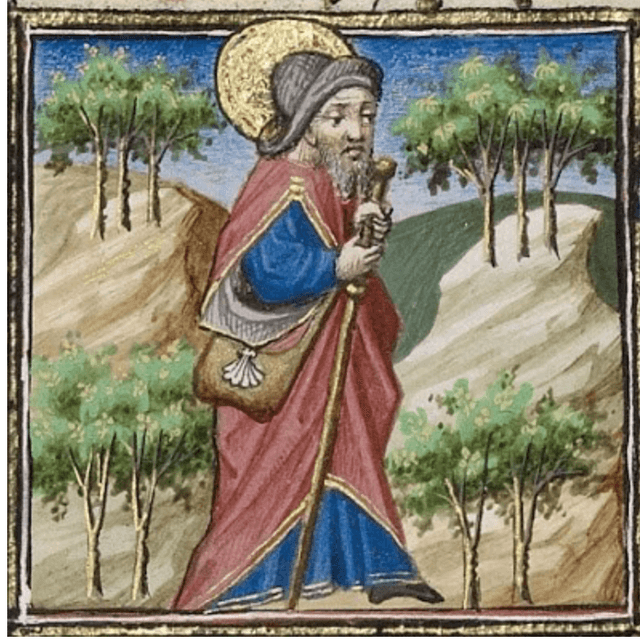
The body of the Apostle was afterwards taken to Compostella, in the province of Gallicia, in Spain, where his grave is very famous. Multitudes of pilgrims from all parts of the earth betake themselves thither to pray, out of sheer piety or in fulfilment of vows. The Birthday of James is kept by the Church upon this day, which is that of the bringing of his body to Compostella. It was about Easter-time that he bore witness to Jesus Christ with his blood, at Jerusalem, being the first of the Apostles to do so.
Seventh Lesson
The Lesson is taken from the Holy Gospel according to Matthew (xx. 20.)
At that time: Came to Jesus the mother of Zebedee's children, with her sons, worshipping Him, and desiring a certain thing of Him. And so on.
Homily by St. John Chrysostom, Patriarch of Constantinople.
Let no man be troubled if we say that the Apostles were still imperfect, for the mystery of the Cross was not yet finished, the grace of the Spirit had not yet been shed abroad in their hearts. If thou wilt behold them in their strength, consider them such as they became after the grace of the Spirit was given them, and thou wilt perceive that they had trodden under foot every vain desire.
This is the cause wherefore their present imperfection is made known unto us, that is, that thou mayest see how great a change could be forthwith wrought by grace. But nevertheless let us now look how they came unto Christ, and what they said. Master, they said, we would that Thou shouldest do for us whatsoever we shall desire. And He said unto them: What would ye that I should do for you? Not, surely, that He knew not what their wish was, but that He would make them answer, and so uncover the wound, to lay a plaster upon it.
Eighth Lesson
Their wish proceeded from earthly motives, and they were shy and ashamed to express it, and therefore they took Christ apart, and so asked Him. To me it seemeth most likely that they had heard how that the disciples should sit upon twelve thrones; they were fain to obtain for themselves the chiefest places at this enthronement; they knew that the Lord loved them better than the most of the others; but they feared that Peter would still be preferred before them.
Therefore they made bold to say: Grant unto us that we may sit, one at Thy right Hand, and the other at Thy left Hand, in Thy glory. They were even instant with Him, saying: Say that we may. And what answered He? To show that they were asking no spiritual gift, nor even knew for themselves what they were asking, nor would have asked it if they had known what it was, Jesus said unto them: Ye know not what ye ask. Ye know not how great a thing, how wonderful a thing this is, a thing which even is not Mine to give.
Ninth Lesson
And He said moreover: Are ye able to drink of the cup that I shall drink of, and to be baptized with the baptism that I am baptized with? Behold how He turneth their thoughts at once another way, speaking to them of things altogether different, as though He said, Ye come unto Me treating of honours and crowns, but I speak unto you of the wrestling and the sweat. This is not yet the time of reward, neither is My glory immediately to be revealed; but now death and danger are present with you.
But consider how, by the manner of His questioning, He doth both exhort and invite them. He saith not: Are ye able to bear death? Are ye able to shed your blood? But: How are ye able to drink the cup? Whereto He presently inviteth them, saying: the cup that I shall drink of; that He may make them readier for the strife by knowing that it is a strife which they are to share with Him.
Walk with Holy Mother Church
Holy Mother Church has already begun praying. Enter her prayer.
Today the Roman year keeps St. James the Greater, Apostle. Receive the observance from the Church's hands: first understand what is commemorated, then let its doctrine and worship shape the day.
Roman Martyrology
July 25
OT. JAMES the Apostle, brother of the blessed evangelist John, who was beheaded by Herod Agrippa about the feast of Easter. His sacred bones were on this day carried from Jerusaelm to Spain, and placed in the remote province of Galicia, where they are devoutly honored by the far-famed piety of the inhabitants, and the frequent concourse of Christians, who visit them through piety and in fulfilment of their vows. — In Lycia, in the time of Decius, St. Christopher, martyr. Being scourged with iron rods, cast into the flames, from which he was saved by the power of Christ, and finally transfixed with arrows and beheaded, he completed his martyrdom. — At Barcelona, in Spain, during the persecution of Diocletian and under the governor Dacian, the birthday of the holy martyr Cucuphas. After overcoming many torments, he was struck with the sword, and thus went triumphantly to heaven. — In Palestine, St. Paul, a martyr, in the persecution of Maximian Galerius, and under the governor Firmilian. He was condemned to capital punishment, but having obtained a short respite to pray, he besought God with all his heart, first for his own countrymen, then for the Jews and the Gentiles, that they might embrace the true faith, next for the multitude of the spectators, and finally for the judge who had condemned him and the executioner that was to strike him; after which he received the crown of martyrdom by being beheaded. — In the same country, St. Valentina, a virgin, who was led to an altar to offer sacrifice, but overturning it with her foot, she was cruelly tortured, and being cast into the fire with another virgin, her companion, she went to her spouse. — At Forcono, in Abruzzo, the holy martyrs Florentius and Felix, natives of Sipontum. — At Cordova, St. Theodemirus, monk and martyr. — At Treves, St. Magnericus, bishop and confessor.
Gospel of the Day
Can you drink the chalice?
St. James the Greater, Apostle - Matthew 20:20-23
“Can you drink the chalice that I shall drink?”
Bring ambitious desires to Christ instead of hiding them. Ask Him to turn the desire for recognition into willingness to serve, obey, endure hardship, and remain faithful.
Receive the Gospel with Holy Mother Church
James and John had sought places of honor beside Christ. Our Lord answered by asking whether they could drink His chalice, meaning whether they were willing to share His obedient suffering and sacrifice.
The apostles answered, "We can." Christ foretold that they would indeed share His chalice, and St. James fulfilled that promise when Herod Agrippa had him killed with the sword.
Christ corrected their ambition without casting them away. He taught them that greatness in an Apostle is found in serving others, obeying God, and remaining faithful through suffering rather than possessing earthly rank.
This Gospel corrects a danger that can quietly deform Catholic judgment: The ambition that desires recognition or authority while refusing humble service and personal sacrifice. Ask where that danger seeks your consent today, and answer it with the act Our Lord requires.
Learn from Today's Saint or Feast
St. James the Greater
An Apostle who followed Christ through preaching, suffering, and martyrdom.
An Apostle is a man personally chosen and sent by Jesus Christ to preach the Gospel and help establish His Church. St. James the Greater was a fisherman, the son of Zebedee and the brother of St. John. Christ called both brothers to leave their nets and follow Him.
James was one of the three Apostles whom Christ chose to accompany Him at especially important moments. He saw the Transfiguration, when Christ revealed His divine glory on the mountain; he witnessed Christ raise the daughter of Jairus from death; and he entered Gethsemani with Christ on the night before the Crucifixion.
When fidelity costs more than expected, remember St. James. Ask Christ for courage to remain obedient and charitable in suffering, just as the apostle remained faithful through mission and martyrdom.
The Pilgrim's Spiritual Conference
The Faith Must Be Confessed Publicly
Remain here for a little while. Receive today's Catholic truth as a child of Holy Mother Church; let it judge the heart, strengthen the will, and become an act offered to God.
The Church places this truth before you today: Catholic faith is not a private sentiment. It must be confessed, defended, and lived before men when duty requires it. Do not hurry past it as though doctrine belonged only to books and controversies. A revealed truth is also a light by which the soul must judge its loyalties, its fears, its habits, and the duties immediately before it. The Church is sent to all nations. Her public confession cannot be reduced to hidden feeling or private preference.
The grace to be practiced is Apostolic courage: courage to profess Christ, serve others, and remain faithful under suffering, drawn from today's saintly witness. Ask God for more than the natural appearance of this virtue. Temperament may make an action seem easy for a time, but supernatural virtue remains faithful because God is worthy of obedience, even when feeling offers no assistance and no one notices the cost. Practice separation from worldly corruption while remaining faithful to every duty of charity, justice, vocation, and necessary human society.
There is also an enemy to recognize: Resist cowardly peace when silence would imply consent to error. Do not study this danger only in other people. Look quietly for the door by which it seeks entrance into your own soul - perhaps through delay, curiosity, resentment, human respect, attachment to comfort, or the desire to control the outcome. Dying to self today means choosing apostolic courage: courage to profess Christ, serve others, and remain faithful under suffering when pride, comfort, fear, resentment, or human respect asks for control.
Do the faithful act and entrust its fruit to divine Providence, God's wise and loving governance of all things. Place effort and outcome into Our Lady's hands so that the whole offering may be presented to her Divine Son. Confidence in God is not passivity: obey, pray, work, and accept that visible success, consolation, or immediate relief may not be given. God remains faithful when the duty is hidden and the outcome uncertain. Therefore, perform the duty that belongs to you, use the lawful means God has provided, and then surrender the fruit. Accept exclusion, ridicule, inconvenience, and lost advantage rather than inhale error or soil the soul through conformity. Reject both the mud and dust of worldly corruption, build the contrary Catholic order, and pray for those carried by the torrent.
The Church's witness
This truth manifests the Church's mark of catholic. The witness placed beside it today is St. Athanasius.
Your resolution before God
Accept the duties you would rather avoid and perform them without seeking recognition.
Christ heals ambition by teaching the soul to serve and suffer with Him.
Carry this word quietly. Return to it when distraction, temptation, or discouragement begins to scatter the soul.
The Little Rule of Fidelity
Keep the day within prayer.
These anchors do not change because the soul needs a stable rule more than a daily novelty. Open them when you are learning the rule or when your ordinary prayer has begun to loosen.
Show today's prayer and duty anchors
Begin with morning prayer
Adore the Blessed Trinity and offer the whole day to Jesus through Mary before other duties claim the mind.
Keep the Angelus
Pause morning, noon, and evening to remember the Incarnation.
Seek Our Lord in the Blessed Sacrament
Attend Holy Mass when duty permits; otherwise make a Spiritual Communion and renew desire for Jesus in the Blessed Sacrament.
Return to Jesus and Mary
Use frequent holy aspirations during work, waiting, suffering, and temptation.
Pray the Rosary
Keep the mysteries of Christ before the mind with Our Lady and learn to imitate what they contain.
End with night prayer and examen
Give thanks, confess faults, forgive injuries, make a practical amendment, and entrust the night to Our Lady.
The Pilgrim's Mirror
How shall I imitate Christ today?
“The most noble and the most perfect victory is for a man to have the victory of himself.”
Victory over others can feed pride; victory over self-will makes room for Christ. Ask for the grace to conquer the fault that most often conquers you.
Choose the fault by its frequency, not by how dramatic it appears. The repeated impatient tone, indulgent thought, delayed prayer, or unnecessary complaint may govern more of life than a rare great trial. Meet it today at its first small demand, while grace makes refusal possible.
Today's Practice
Choose the harder faithful act once, quietly and at once.
Before Night Falls
Return the completed day to God.
Give thanks before measuring the day by feeling or visible success. Ask light to see faults without discouragement, make an Act of Contrition, forgive injuries, and place tomorrow beneath divine Providence.
Examine what entered through the world's atmosphere, cleanse every stain through contrition, and strengthen tomorrow's boundaries.
- For what grace or mercy should I thank God today?
- What sin, fault, neglected duty, or resistance to grace must I confess?
- What definite amendment will I carry into tomorrow?
Go Now, Pilgrim
Walk faithfully. Pray attentively. Bear your cross willingly. Love God above all things.
Holy Mother Church has gathered you around her prayer and truth; now carry what you have received into the duties of your state.
When this day is finished, may you have laid one more stone in the City of God.
You do not walk alone: remain beneath Our Lady's care as she leads you toward her Divine Son and the Heavenly Jerusalem.
God willing, we shall meet again at tomorrow's pilgrimage.
Source notes for this pilgrimage
Martyrology: The Roman Martyrology, Baltimore, 1916, John Murphy Company; local raw text lines 7570-7617.
- Gospel: Matthew 20:20-23; Acts 12:1-2, Douay-Rheims.
- Gospel: Traditional Roman Gospel for St. James the Greater.
- Saint witness: Matthew 20:20-23; Acts 12:1-2, Douay-Rheims.
- Saint witness: Roman Martyrology, 1916 Baltimore edition, July 25.
- Saint witness: St. Andrew Daily Missal, July 25.
- Breviary witness: Roman Breviary, Matins lessons for July 25, St. James the Greater.
- Breviary witness: Matthew 20:20-23; Acts 12:1-2, Douay-Rheims.
- Matins lesson: The Roman Breviary, translated by John, Marquess of Bute, 1908, vol. III, Summer, Second Nocturn for St. James the Greater, lessons iv-vi, and Third Nocturn, lessons vii-ix.
- Matins lesson: Bute 1908 is used here as an accessible pre-Pius X Breviary witness and is cited distinctly from the 1936-1937 Benziger / Burns Oates edition.
Pilgrim's Mirror: Thomas à Kempis, The Imitation of Christ, translated by Richard Whitford, edited by Wilfrid Raynal, O.S.B. (Mount Vernon, N.Y.: Peter Pauper Press, c. 1947). Today's passage is at Book III, chapter 53, p. 159.
Marian formation: St. Louis-Marie de Montfort, True Devotion to the Blessed Virgin, translated by Fr. Frederick William Faber, 1941 Company of Mary edition, imprimatur September 26, 1949. Today's passage is at True Devotion to the Blessed Virgin, no. 89. The supplied 2010 PDF is used only as a digital transcription of that pre-1955 edition.
- Devotional rhythm: St. Andrew Daily Missal, Dom Gaspar Lefebvre, O.S.B., 1953 edition; proper Mass or devotion named in this entry.
- Devotional rhythm: 1 Peter 1:18-19, Douay-Rheims.
- Devotional rhythm: Matthew 28:19, Douay-Rheims.
- Faith point: St. Athanasius, defense of Nicene faith.
- Faith point: Baltimore Catechism, lessons on faith and confession of faith.
- Marian atmosphere and imitation: Luke 1:38, 46-49; Luke 2:19; John 2:5; John 19:25-27; and John 3:30, Douay-Rheims.
- Authority and revolt: Exodus 5:2, Douay-Rheims.
- Daily examen: St. Ignatius of Loyola, Spiritual Exercises, Particular and Daily Examen.