Watchtower of Errors
Watchtower of Errors: doctrines named clearly from the safety of truth so they can be resisted.
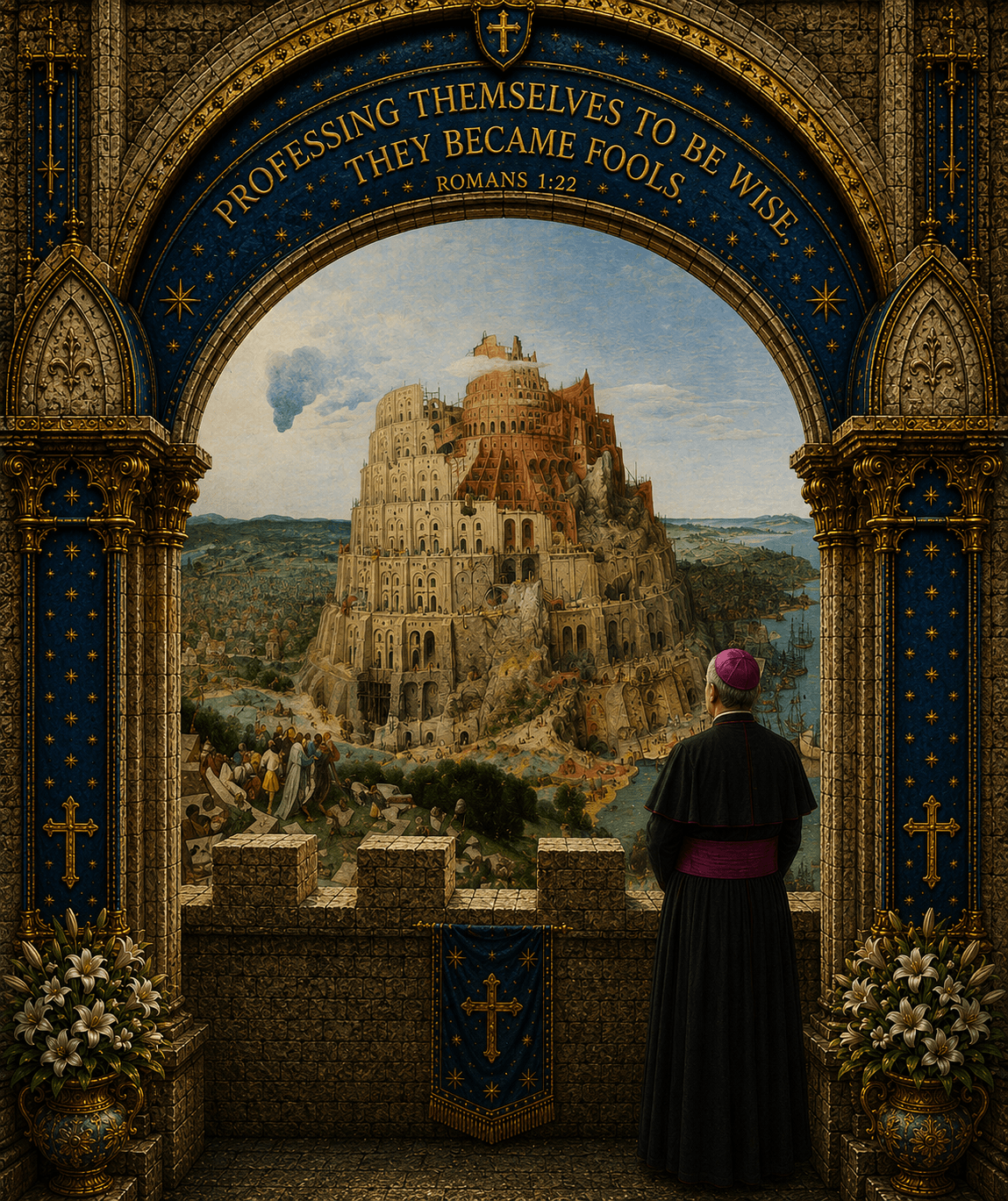
Watchtower of Errors
66 published chapters
The watchtower of errors: doctrinal and philosophical enemies named from the walls so they can be resisted.
From the walls of the City, these errors are named below in doctrinal order.
“Take heed that no man seduce you.”
— Matthew 24:4, Douay-Rheims
The Watchtower is not a place of controversy for its own sake. Its purpose is to preserve the Deposit of Faith by allowing Sacred Scripture, the Fathers, the Doctors, and the Roman Pontiffs to warn the faithful in their own words. Love of truth requires vigilance: the pilgrim must learn not only what to embrace, but what to guard against.
The Watchtower exists because every generation must receive the Faith, guard the Faith, live the Faith, and hand the Faith on unchanged.
The Wisdom Treasury teaches what the pilgrim must believe, love, and practice. The Watchtower teaches what he must recognize and reject. Together they form the soul without making truth abstract: every doctrine and every warning must lead to Our Lord Jesus Christ, His , true worship, the , of life, and perseverance in .
Error has a fate: it is judged by truth, exposed by the Faith, hated by , refused by , and condemned by God. It is not harmless confusion when it is received, loved, preached, excused, or disguised as mercy. It is a mortal weapon against souls. It darkens the mind, corrupts worship, weakens repentance, excuses sin, and attempts to draw souls away from the truth by which they must be saved.
The judgment here is simple and Catholic: truth can be found, error can be found, and the soul must not confuse of Christ with the corruption that imitates her. A soul that cannot distinguish truth from error cannot safely distinguish the Good Shepherd from the , the altar from the stage, mercy from permission, from contradiction, or from .
These errors are not marks of the and spotless . is one, holy, Catholic, and apostolic; she receives truth from her Lord and cannot give her children poison as though it were bread. Sinners may be found among her members, and men may misuse offices, language, and outward structures; but errors such as , , doctrinal relativism, , liberalism, and do not proceed from as . They belong to the city of man, to corruption, and to the enemies that must be named and resisted.
The true is knowable by the Faith she guards, the worship she preserves, the she keeps, the she receives from Christ, and the holiness she bears from Him. is known by her adulterous commerce with every false worship, every false doctrine, every power, and every peace purchased by betrayal. She has room for every contradiction because she is not governed by the Bridegroom's truth.
is especially revealing. does not mingle with idols. She calls all nations to Christ and all errors to defeat. has relations with everyone and everything: false altars, false prophets, false moralities, false philosophies, false politics, and false peaces. She calls this breadth. It is adultery against truth.
Therefore the treatment of error must be severe in the right sense: exact, sober, and unafraid. do not always announce themselves with open hatred of Christ. Often they come with soft language, administrative power, sentimental mercy, , false unity, and peace. Their work must be exposed because souls are at stake forever.
There is no holiness where there is no hatred of . The says that souls are too busy trying to become holy to worry about the crisis, but that is how sheep are kept calm in the wrong pasture. Holiness does not close its eyes to poison. does not make peace with . Fidelity does not call error a harmless opinion.
The faithful must learn holy refusal: no to false worship, no to false doctrine, no to false shepherds, no to , no to , no to , no to every pasture where sheep are kept calm while feed.
The Church Warns in Her Own Voice
Each Watchtower treatment begins with the principal Scriptural warnings, then gathers the directly relevant testimony of the Fathers. The solemn judgments of the Roman Pontiffs ordinarily form its heart, followed where useful by the Doctors and approved spiritual writers. The conclusion must name the Catholic truth contradicted by the error and the concrete duties by which the pilgrim holds fast to it.
Foundational documents include Pascendi Dominici Gregis, Lamentabili Sane, the Oath Against , Mirari Vos, Quanta Cura, the Syllabus of Errors, Mortalium Animos, Humanum Genus, Libertas Praestantissimum, Immortale Dei, Satis Cognitum, and In Eminenti Apostolatus Specula. Their exact texts—not modern summaries—must carry the .
The treatment is exact, grave, charitable, and unafraid. Persons are called to conversion and must never be mocked; errors are condemned and must never be softened. The end is not fascination with controversy or servile fear, but fidelity to Christ and confidence in the Catholic Faith.
Core Scope
- Each error is defined plainly.
- Its contradiction to divine revelation is named.
- Its historical and present expression is shown.
- Its opposition to the holiness and unity of is made clear.
- are named where they use Catholic language to smuggle error into souls.
- Its mortal danger to souls is stated without vagueness.
- Truth is defended for the salvation of souls, never for cruelty.
The end is doctrinal clarity, fidelity, hatred of , love of souls, and persevering hope.
Begin here
The Deposit of Faith
Before studying individual errors, learn why the revealed Faith must be received, guarded, and handed down without corruption.
Major study
Modernism
Pope St. Pius X named modernism as the synthesis of all heresies because it keeps Catholic words while dissolving revelation, dogma, Scripture, tradition, worship, and obedience from within.
Common false conclusion
Home Alonerism
Some souls rightly flee false worship and then wrongly make permanent domestic isolation into a principle. The home is holy, but it is not a substitute for the Church's public worship, sacraments, and visible order.
All Watchtower Studies
Begin with the Deposit of Faith. Each error is then named and answered for instruction, correction, and the salvation of souls.
The Deposit of Faith
The Fathers Against Heresy
Indifferentism
Religious Relativism
False Ecumenism
Religious Liberty / Rights of Error
False Mercy
Private Judgment
Gallicanism / Conciliarism
Modernism
- The Faith Is Not Remade by the Age
- Religious Experience Is Not Revelation
- Dogma Does Not Change Meaning
- Scripture, History, and the Rule of Faith
- Pascendi: The Anatomy of the Modernist System
- Lamentabili: Condemned Propositions and the Catholic Boundary
- The Oath as a Rule for Study and Speech
- How to Recognize Modernist Language
- Modernism and False Obedience
- Modernism and Worship
- Modernism and Scripture Criticism
- Modernism and Living Tradition
- Modernism and the Counterfeit Church
- St. Vincent's Rule Against Modernist Development
- Pascendi I: The Duty to Guard the Deposit
- Pascendi II: The Modernist Method, Agnosticism, and Immanence