The Daily Pilgrimage
Today in the City of God: calendar, Martyrology, Gospel, witness, prayer, and Catholic formation held together.
Daily formation
2030-06-12
Receive the day before spending it. Magnify Christ with Our Lady, obey God's commandments, fulfill the duties of your state in life, die to self, trust divine Providence, practice the virtues those duties require, resist error, and close the whole day beneath truth and mercy.
This page is meant to be read slowly and faithfully, so that every part of the present day may be ordered to God.
Choose a date
Daily navigation
Within the Privileged Octave of Pentecost
City of God in Exile
Within the Privileged Octave of Pentecost
2030-06-12 - Eastertide - Privileged Octave of the First Order - red
Today
Within the Privileged Octave of Pentecost
The Heart Opened for Sinners
Truth
The Cross Is Daily
The disciple of Christ must deny himself, take up his cross daily, and follow Our Lord in obedience, penance, and perseverance.
Practice
Docility to the Spirit of truth.
Offer today's sacrifices in reparation and surrender every excuse for the faults you already know.
Offering
To Jesus through Mary
Ask Our Lady to lead you beyond spiritual mediocrity into intimate union with Our Lord and complete fidelity to the Holy Ghost.
The Pilgrim's Devotional Rhythm
Keep this month and this weekday in prayer.
The month's intention and the weekday remembrance gather the pilgrim's prayer into the devotional rhythm of the Church. In harmony with today's Mass, feast, and duties, they teach him to receive ordinary time from God and return it to Him in honor and intercession.
June intention
The Most Sacred Heart of Jesus
The Sacred Heart reveals the human love of the Incarnate Word, burning for His Father's glory and the salvation of souls. Draw near in reparation, obedience, and confidence rather than sentiment alone.
Intention
For reparation to the Sacred Heart, the conversion of sinners, and hearts made meek, humble, and faithful to the commandments of Christ.
A faithful act
Accept contradictions without resentment and offer them in reparation for coldness toward Our Lord.
Prayer
Most Sacred Heart of Jesus, have mercy on us and make our hearts like unto Thine.
Wednesday remembrance
St. Joseph
Midweek, turn to St. Joseph, whose hidden labor guarded Jesus and Mary. He teaches authority without self-importance, work without complaint, and silence joined to decisive obedience.
Intention
For fathers, laborers, families, the protection of the Church, and those approaching death.
A faithful act
Do necessary tasks thoroughly without seeking notice or praise.
Prayer
St. Joseph, patron of the universal Church, guard our homes and obtain for us purity, courage, and a holy death.
Good Morning, Pilgrim
Receive this day from God.
The feast of the Most Sacred Heart contemplates the Heart of Jesus opened by the lance after His sacrifice on Calvary. His tenderness is not permission to remain in sin: it calls the contrite soul to gratitude, reparation, conversion, and obedient love in return for divine charity.
Offer all prayers, duties, sacrifices, relationships, possessions, and powers to Jesus through Mary for complete fidelity today.
Formation in True Devotion - Day 193: Review and Deepening: Mary's Spiritual Reign and Necessity in God's Order
“If devotion to the most holy Virgin Mary is necessary to all men, simply for working out their salvation, it is still more so for those who are called to any particular perfection.”
Every Christian is commanded to be perfect according to his state, and some receive particular offices, graces, trials, or calls requiring still greater generosity. St. Louis de Montfort permits no Marian minimalism: devotion should deepen the soul's union with Our Lord and its fidelity to the Holy Ghost.
Do not ask how little prayer, sacrifice, obedience, or charity will suffice. Ask how completely grace may possess you. This generosity does not invent duties or neglect prudence; it fulfills the whole law of God, all obligations of one's state, and the inspirations of grace with greater purity, courage, and love.
Ora — Begin with Prayer
Offer the day before spending it
Prayer gives the day its right beginning and its right end. Before work, conversation, news, or distraction claims the mind, adore the Blessed Trinity and offer every prayer, work, joy, suffering, and temptation to Jesus through Mary. Ask your Guardian Angel for help, and place the souls and needs entrusted to you beneath God's will.
Begin simply. Make the Morning Offering through the hands of Our Lady. Pray the Three Hail Marys for purity and final perseverance, ask your Guardian Angel to govern the senses and imagination, and name the soul or intention for which today's prayers and sacrifices will be offered. Do not rush these acts merely because they are familiar; let them place the whole day beneath God before the world begins to claim it.
O most Sacred Heart of Jesus, receive my contrition and cure my coldness. Teach me to answer Thy wounded love with reparation, obedience, and mercy toward others.
Quote of the Day
“Whatever the Roman Pontiffs have hitherto taught must be held with a firm grasp of mind.”
Plain-language help for today - 3 unfamiliar terms
Within the Privileged Octave of Pentecost is the principal observance today. The calendar also preserves St. John of St. Facundo, Confessor on this date. The secondary saint and Breviary sermon or lesson panels below come from that secondary observance. That material adds another traditional lesson for the date; it does not replace the principal observance.
- Octave
- an eight-day extension of a major feast, allowing the Church to continue praying over the same mystery.
- Commemoration
- a shorter liturgical remembrance of another saint or observance occurring on the same day.
- Martyr
- a Christian who was killed rather than deny Christ or abandon the Faith.
The full Breviary lessons preserve an older English translation. Read the modern explanation first; it identifies the people, event, and doctrine before the historical wording appears.
Today's Full Breviary Sermon or Proper Lesson
Peace restored by truth, priestly courage, and the Holy Sacrifice.
Matins - Second Nocturn - St. John of St. Facundo, Confessor, with Ss. Basilides, Cyrinus, Nabor, and Nazarius, Martyrs
The complete appointed Breviary sermon or proper lessons verified for this observance are printed below. Where a Common supplies additional material, it is identified distinctly rather than presented as the proper text.
Roman Breviary, Proper lessons for St. John of St. Facundo and the commemorated martyrs
“By sermons and private conversations he restored the city to tranquility.”
- The Breviary shows St. John renouncing benefices and episcopal favor so that he could serve God more quietly through daily Mass, preaching, study, religious poverty, obedience, humility, vigils, and prayer.
- He restored peace to Salamanca not by avoiding truth but by preaching, private correction, and courageous opposition to cruelty. His peacemaking risked retaliation because charity defended those subject to injustice.
- His priestly life was centered on the Holy Sacrifice, where he was favored with contemplation of Christ. The commemorated martyrs complete the lesson: peace with God requires steadfast confession and contempt for idolatrous commands.
Seek peace beneath truth and the altar. Renounce ambition, receive discipline, correct cruelty even when it is dangerous, reconcile enemies through Catholic charity, and refuse every peace that demands silence before idolatry or injustice.
Complete Breviary Text
Fourth Lesson - Benefices Renounced for Prayer and Preaching
John was born of a noble family at Sahagun in Spain. After his parents had long remained without children, they obtained him from God by pious works and prayers. From his earliest years he gave remarkable signs of future holiness, for he often spoke to other boys from a higher place, exhorting them to virtue and the worship of God and settling their quarrels. In his native place he was entrusted for his first instruction to the monks of St. Facundus of the Order of St. Benedict. While he pursued these studies, his father arranged for him to administer a parish, but no argument could induce the young man to retain that office. He entered the household of the Bishop of Burgos and, because of his proven integrity, became his intimate companion. The bishop ordained him priest and canon and enriched him with many benefices. But John left the episcopal court so that he might serve God more quietly, renounced all ecclesiastical revenues, and attached himself to a chapel where he offered the Holy Sacrifice daily and frequently preached on divine things to the great edification of his hearers.
Fifth Lesson - Religious Discipline amid a Violent City
He afterwards went to Salamanca for study and was admitted to the celebrated College of St. Bartholomew. He exercised the priestly ministry while pursuing his desired studies and was continually engaged in sacred preaching. When he fell into a most serious illness, he bound himself by a vow to stricter discipline. In fulfillment of it, after first giving to an almost naked poor man the better of the only two garments he possessed, he entered the monastery of St. Augustine, which then flourished in severe discipline. Once admitted, he surpassed the more advanced religious in obedience, humility, vigils, and prayer. When care of the refectory was entrusted to him, a small cask of wine which he touched supplied all the monks abundantly for a year. After completing the year of probation, he undertook preaching at the command of his superior. At that time Salamanca was so disturbed by bloody factions that murders occurred almost every hour and not only its streets and squares but even its churches ran with the blood of men of every rank, especially the nobility.
Sixth Lesson - Courageous Peacemaking before Christ
John softened the hearts of the citizens by sermons and private conversations and restored the city to tranquility. He gravely offended a powerful man by rebuking his cruelty toward his subjects. The man therefore sent two horsemen to kill John on the road. They had already drawn near when, struck by a divinely sent stupor, they and their horses remained immovable until they cast themselves at the saint's feet and begged pardon for their crime. The powerful man himself, suddenly struck with terror and despairing of his safety, recalled John, repented of his deed, and was restored to health. Factious men who attacked him with clubs likewise found their arms rigid and did not recover their strength until they begged pardon. John was accustomed to behold Christ the Lord present while he offered the Holy Sacrifice and to draw heavenly mysteries from the divine fountain itself. He frequently discerned the secrets of hearts and foretold future things. At last, having foretold the day of his death and received the sacraments of the Church with great devotion, he ended his earthly course, glorious for many miracles before and after death. After these had been duly proved, Pope Alexander VIII enrolled him among the Saints.
Commemoration - Ss. Basilides, Cyrinus, Nabor, and Nazarius
Basilides, Cyrinus, Nabor, and Nazarius were Roman soldiers, noble by birth and distinguished by courage. Having embraced the Christian religion, they preached Christ the Son of God under the Emperor Diocletian. Arrested by Aurelius, prefect of the City, and commanded to sacrifice to the gods, they despised his orders and were sent to prison. While they prayed, a suddenly arisen and most brilliant light filled the prison before the eyes of all who were there. Moved by that heavenly splendor, Marcellus the jailer and many others believed in Christ the Lord. Later they were released from prison and brought before the Emperor Maximian. Since they disregarded his command also and had only Christ, God and Lord, upon their lips, they were tortured with scorpions and again cast into bonds. Brought out on the seventh day and set before the emperor, they persisted in mocking the empty gods and most steadfastly confessed Jesus Christ as God. They were therefore condemned and beheaded. Their bodies, exposed to wild beasts but left untouched by them, were honorably buried by Christians.
Walk with the Church
The Church has already begun praying. Enter her prayer.
Today the Roman year keeps Within the Privileged Octave of Pentecost. Receive the observance as the Church gives it: first understand what is commemorated, then let its doctrine and worship shape the day.
Roman Martyrology
June 12
At Salamanca, in Spain, St. John of St. Facundus, confessor, of the Order of Augustinians, renowned for his zeal for the faith, for holiness of life, and miracles. — At Rome, on the Aurelian road, during the persecution of Deems and under the prefect Aurelius, the birthday of the holy martyrs Basilides, Cyrinus, Nabor, and Nazarius, soldiers, who were cast into prison for the confession of the Christian name, scourged with scorpions, and finally decapitated. — At Mcaea, in Bithynia, St. Antonina, martyr, who was scourged by order of the governor Priscillian during the same persecution, then racked, lacerated, exposed to the fire, and finally put to the sword. — In Thrace, St. Olympius, a bishop, who was expelled from his see by the Arians, and died a confessor. — At Rome, in the Vatican basilica, the pope St. Leo III., to whom God miraculously restored his eyes and his tongue after they had been torn out by impious men. — In Cilicia, the bishop St. Amphion, a celebrated confessor of the time of Galerius Maximian. — In Egypt, St. Onuphrius, an anchoret, who for sixty years led a religious life in the desert, and renowned for great virtues and merits, departed for heaven. His admirable deeds were recorded by the abbot Paphnutius.
Learn from Today's Saint or Feast
The Octave of Pentecost
The fire of the Holy Ghost kept before the Church.
The privileged Octave of Pentecost prolongs the descent of the Holy Ghost, keeping the Church within the mystery of divine fire, truth, charity, and apostolic courage.
The octave teaches that Pentecost is not enthusiasm. The Spirit of truth strengthens the Church to confess Christ, keep His commandments, and carry doctrine to the nations.
Stay inside Pentecost. The exile needs fire, but it must be the fire of truth and charity, not the fever of novelty.
Secondary Saint or Commemoration
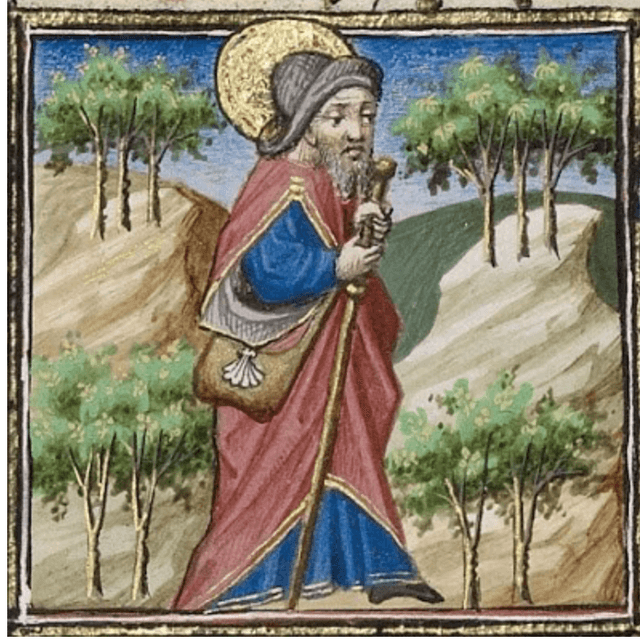
St. John of St. Facundo
Confessor of peace, preaching, and Eucharistic reverence.
St. John of St. Facundo is honored as a confessor of the Augustinian Order, remembered for preaching, peace-making, and devotion to the Holy Sacrifice.
His feast teaches that peace must be made beneath truth. A priestly soul does not heal quarrels by pretending sin and error do not matter, but by bringing men back under God.
Ask St. John for peace that is not cowardice. Reconciliation becomes Catholic when it returns souls to truth, worship, and grace.
The Pilgrim's Spiritual Conference
The Cross Is Daily
Remain here for a little while. The purpose is not to gather another fact, but to allow today's Catholic truth to judge the heart, strengthen the will, and become an act offered to God.
The Church places this truth before you today: The disciple of Christ must deny himself, take up his cross daily, and follow Our Lord in obedience, penance, and perseverance. Do not hurry past it as though doctrine belonged only to books and controversies. A revealed truth is also a light by which the soul must judge its loyalties, its fears, its habits, and the duties immediately before it. Holiness is formed in ordinary fidelity before it is tested in public suffering.
The grace to be practiced is Docility to the Spirit of truth, drawn from today's saintly witness. Ask God for more than the natural appearance of this virtue. Temperament may make an action seem easy for a time, but supernatural virtue remains faithful because God is worthy of obedience, even when feeling offers no assistance and no one notices the cost. Practice magnanimity by pursuing the whole holiness God asks, without bargaining for a merely adequate or comfortable spiritual life.
There is also an enemy to recognize: Resist a comfortable religion that admires Christ while refusing self-denial. Do not study this danger only in other people. Look quietly for the door by which it seeks entrance into your own soul - perhaps through delay, curiosity, resentment, human respect, attachment to comfort, or the desire to control the outcome. Dying to self today means choosing docility to the Spirit of truth when pride, comfort, fear, resentment, or human respect asks for control.
Do the faithful act and entrust its fruit to divine Providence, God's wise and loving governance of all things. Place effort and outcome into Our Lady's hands so that the whole offering may be presented to her Divine Son. Confidence in God is not passivity: obey, pray, work, and accept that visible success, consolation, or immediate relief may not be given. God remains faithful when the duty is hidden and the outcome uncertain. Therefore, perform the duty that belongs to you, use the lawful means God has provided, and then surrender the fruit. Accept the greater purification, labor, patience, and perseverance required when grace calls you beyond mediocrity. Fulfill all duties thoroughly, answer every known demand of charity, and use every grace received for God's glory and souls.
The Church's witness
This truth manifests the Church's mark of holy. The witness placed beside it today is St. Bede the Venerable.
Your resolution before God
Offer today's sacrifices in reparation and surrender every excuse for the faults you already know.
The mercy of the Sacred Heart heals the sinner by drawing him out of sin.
Carry this word quietly. Return to it when distraction, temptation, or discouragement begins to scatter the soul.
The Little Rule of Fidelity
Keep the day within prayer.
These anchors do not change because the soul needs a stable rule more than a daily novelty. Open them when you are learning the rule or when your ordinary prayer has begun to loosen.
Show today's prayer and duty anchors
Begin with morning prayer
Adore the Blessed Trinity and offer the whole day to Jesus through Mary before other duties claim the mind.
Keep the Angelus
Pause morning, noon, and evening to remember the Incarnation.
Seek Our Lord in the Blessed Sacrament
Attend Holy Mass when duty permits; otherwise make a Spiritual Communion and renew desire for Jesus in the Blessed Sacrament.
Return to Jesus and Mary
Use frequent holy aspirations during work, waiting, suffering, and temptation.
Pray the Rosary
Keep the mysteries of Christ before the mind with Our Lady and learn to imitate what they contain.
End with night prayer and examen
Give thanks, confess faults, forgive injuries, make a practical amendment, and entrust the night to Our Lady.
The Pilgrim's Mirror
How shall I imitate Christ today?
“Ask not who said this, but take heed what is said.”
Truth does not become true through fashion, applause, or a celebrated name. Test what you hear by revelation and the perennial teaching of the Church.
Yet Thomas à Kempis also rebukes the curiosity that collects authorities without receiving their doctrine. Listen for the truth God is giving through a trustworthy witness, and then permit that truth to correct you. A holy author's name should not become decoration around an unchanged life.
Today's Practice
Reject claims based on novelty or popularity and ask what the Church has always taught.
Before Night Falls
Return the completed day to God.
Give thanks before measuring the day by feeling or visible success. Ask light to see faults without discouragement, make an Act of Contrition, forgive injuries, and place tomorrow beneath divine Providence.
Examine where generosity answered grace and where calculation sought the minimum; repent and renew the gift of your whole self.
- For what grace or mercy should I thank God today?
- What sin, fault, neglected duty, or resistance to grace must I confess?
- What definite amendment will I carry into tomorrow?
Go Now, Pilgrim
Walk faithfully. Pray attentively. Bear your cross willingly. Love God above all things.
When this day is finished, may you have laid one more stone in the City of God.
You do not walk alone: remain beside the Blessed Virgin as she leads you toward her Divine Son and the Heavenly Jerusalem.
God willing, we shall meet again at tomorrow's pilgrimage.
Source notes for this pilgrimage
Martyrology: The Roman Martyrology, Baltimore, 1916, John Murphy Company; local raw text lines 5967-5998.
- Saint witness: Acts 2:1-11, Douay-Rheims.
- Saint witness: St. Andrew Daily Missal, Octave of Pentecost.
- Breviary witness: Roman Breviary, Matins during the Octave of Pentecost.
- Breviary witness: Acts 2:1-11, Douay-Rheims.
- Matins lesson: Breviarium Romanum, Pii Papae X auctoritate reformatum, Desclee & Socii, 1942, Pars Aestiva, June 12, St. John of St. Facundo, lessons iv-vi, and Ss. Basilides, Cyrinus, Nabor, and Nazarius, commemorated lesson ix, printed pp. 612-615.
- Matins lesson: The complete lessons above are faithful editorial English translations prepared directly from the visually checked Latin text; they are not presented as an edition-issued English Breviary translation.
Pilgrim's Mirror: Thomas à Kempis, The Imitation of Christ, translated by Richard Whitford, edited by Wilfrid Raynal, O.S.B. (Mount Vernon, N.Y.: Peter Pauper Press, c. 1947). Today's passage is at Book I, chapter 5, p. 14.
Marian formation: St. Louis-Marie de Montfort, True Devotion to the Blessed Virgin, translated by Fr. Frederick William Faber, 1941 Company of Mary edition, imprimatur September 26, 1949. Today's passage is at True Devotion to the Blessed Virgin, no. 43. The supplied 2010 PDF is used only as a digital transcription of that pre-1955 edition.
- Devotional rhythm: St. Andrew Daily Missal, Dom Gaspar Lefebvre, O.S.B., 1953 edition; proper Mass or devotion named in this entry.
- Devotional rhythm: Matthew 11:29, Douay-Rheims.
- Devotional rhythm: Matthew 1:19-24, Douay-Rheims.
- Faith point: Luke 9:23, Douay-Rheims.
- Faith point: St. Bede the Venerable, traditional commentary on the Gospel.
- Marian atmosphere and imitation: Luke 1:38, 46-49; Luke 2:19; John 2:5; John 19:25-27; and John 3:30, Douay-Rheims.
- Authority and revolt: Exodus 5:2, Douay-Rheims.
- Daily examen: St. Ignatius of Loyola, Spiritual Exercises, Particular and Daily Examen.